Introducing Positron Flux
March 31, 2026 by Marco Cecconi
March 31, 2026 by Marco Cecconi
Over the years, I've wondered why experienced software teams struggle to improve. Why do smart teams keep revisiting the same issues in retros without real progress? Not the "writing better code" variety of issues. The answer, more often than not, is that they're missing three things at once: real data, an explanation of what's driving the data, and a way actually to change it. Usually, you get one, maybe two. Never all three.
I have been a consultant/CTO/lead architect for about 30 years. My role is usually to tackle this sort of issue systematically, and I typically help companies grow from 10 to 100 developers. Companies vary, but a lot of my work is similar: analyse the current status quo, draft a plan to improve the situation and get a budget, iterate on different solutions to make things better, and iterate.
Most of this work is manual. There are open-source tools that help, but they are green. There are paid alternatives, but they are targeted at the enterprise market, and adopting them would make things worse, not better, in the kind of companies I work with. If tools introduce bureaucracy for the developers, or are useless to them, they are also low value to me.
So, in January, I left my corporate CTO job and started building something: Positron Flux.

Positron Flux is a delivery excellence workbench, loosely grounded in DORA research, the most rigorous, longitudinal study of software delivery performance we have. But Positron Flux is a complete system, not just another DORA dashboard.
Dashboards tell you what happened. They don't tell you why it happened or what to do about it. That's a pretty big gap I kept running into after years of leading engineering teams at scale. You'd look at a lead-time spike and spend half a sprint hunting through Git history and Jira tickets to understand the cause. You'd find something, maybe make a change, and then have no way to know if it actually worked.
Positron Flux is built to address this critical gap ignored by other tools: ensuring teams not only know what happened but also why and how to address it within their workflow systematically.
The core concept is simple, but we are spending the necessary time to get it right.
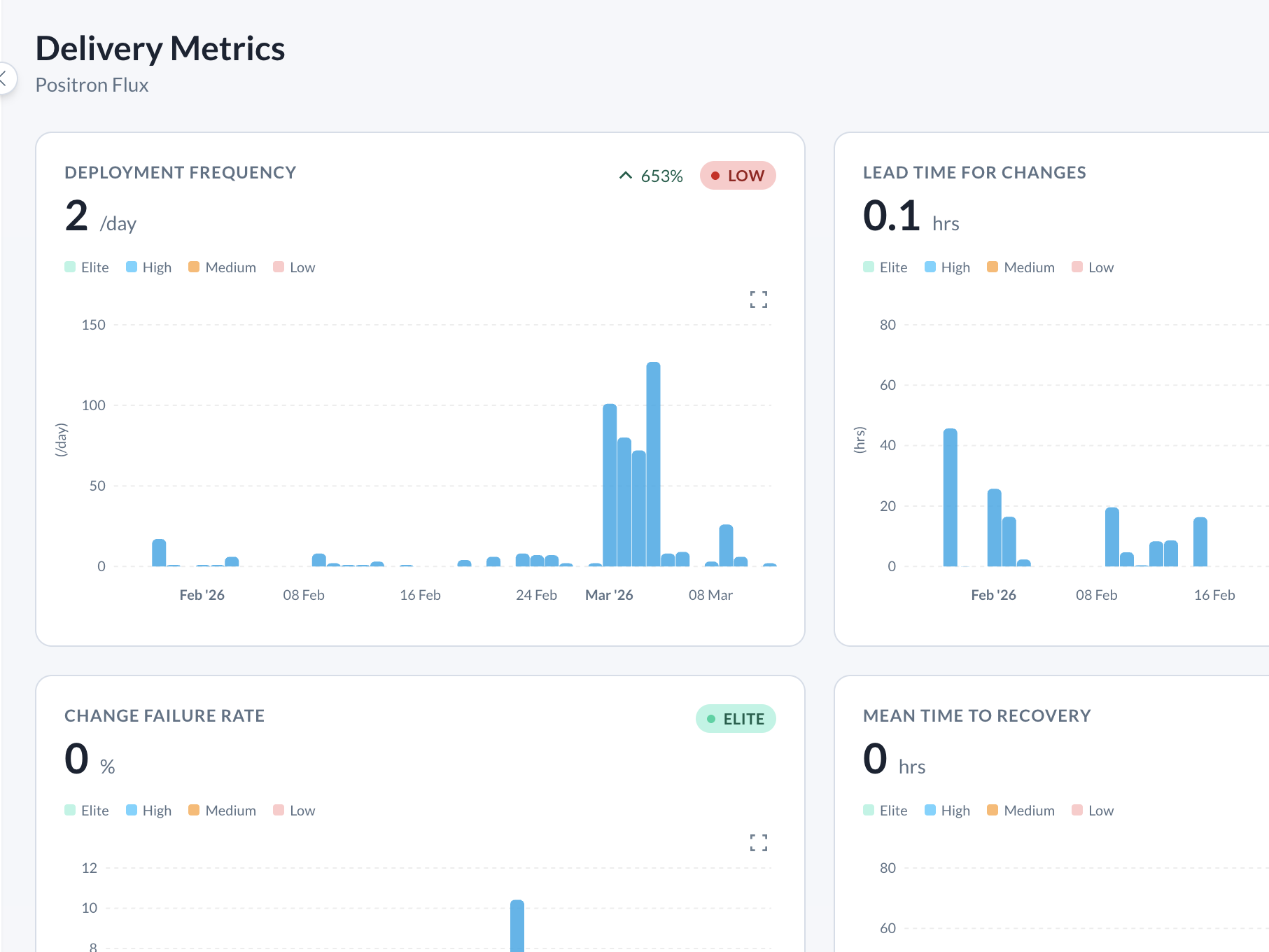
First, you can obviously track your four DORA metrics as time series, benchmarked against industry standards. Filter by team, product, or timeline, generate shareable reports, and schedule automated updates. This is mostly for CTOs and engineering leaders who want to understand the situation and report on it, e.g., to the CEO or the board.
Next, analyse. When metrics change, a correlation engine highlights what shifted. For example, if lead time rises, it indicates linked factors, drawing on over 40 secondary metrics related to DORA outcomes and engineering capabilities. This is for the engineering managers, the people whose job is to debug teams and understand the dynamics in detail. When your CTO kindly suggests you look at why Team Billing never releases their stories, you look at Positron Flux's secondary metrics correlation to understand what's up.
Finally, improve. Positron Flux offers tools that work where your team does, e.g. Slack, GitHub, Jira and 30 other integrations, to actually help your teams do better, systematically. You can measure the impact of these tools through experiments, measure results, and share evidence-based outcomes. Think A/B testing, but for engineering excellence. If you don't know where to start, we offer entire playbooks for guidance. This is for the senior devs, the guys who are knee-deep into coding every day, and they need ways to help their own teams.
I've been on both sides of this problem: as an engineer frustrated that no one could explain why things were slow, and as an engineering leader trying to demonstrate progress to a board without hand-wavy estimates. The tooling in this space has improved a lot in recent years, but it's still fragmented. You stitch together a crappy dashboard, a code quality tool, and an incident tracker, and you end up with numbers nobody agrees on and no coherent story to tell. Plus, I have to do this over and over for every customer and gig.
Positron Flux stands apart as a complete, "actionable" system that supports any engineering leader, CTO, VP of Engineering, EM, or senior dev to see when something is wrong, understand the root cause, and confidently show which actions led to real improvement.
How difficult is it to integrate Positron Flux with our existing tools and workflows?
It's very easy! We try to limit integration setup to a single click, but sometimes you may need to enter an API key, so it's technically two clicks.
What specifically sets Positron Flux apart from other DORA-based or engineering analytics platforms?
It provides a complete set of features, e.g., tools, experiments, to actually improve outcomes, not just report on the situation. Furthermore, our tool is specifically built for startups and scale-ups. It is not corporate and enterprisey. It speaks to your developers in a language they understand, and it's built to drive adoption from the ground up, not the top down. Supporting a strong engineering culture is a top priority for us.
How does Positron Flux handle sensitive engineering and company data?
All sensitive stuff is encrypted in flight and at rest, we have a full audit log of operations, and we try our best to minimise the quantity and sensitivity of data we store, which is always the first and best idea.
Can Positron Flux support organisations larger than 100 developers or those with complex team structures?
Positron Flux has no real limitation on complex organisations. However, large enterprises focus on different approaches and different outcomes than start-ups. Growth is less important than stability. Legacy is more important than innovation. We made a clear choice from the beginning to focus the tool on smaller, more dynamic companies.
What is the expected pricing model for Positron Flux after early access?
We will offer a generous free tier and per-developer pricing for larger companies that need multiple teams, extensive reporting, and other big city tools.
We're opening for early access in Q2 2026. Ready to break the cycle and lead your team to measurable improvement? Join the waitlist today! Just answer a few quick questions about your setup, and be among the first to transform how your team delivers results.
I will be sharing a lot more about the product and its progress in the next few weeks, but for now, sign up to stay in the loop and get exclusive early access and the opportunity to influence the product's direction.
Hi, I'm Marco Cecconi. I am the founder of Positron Lans, developer, hacker, blogger, conference lecturer. Bio: ex Stack Overflow core team, ex Toptal, ex BaxEnergy.
Read moreMarch 31, 2026 by Marco Cecconi
Positron Flux is a new a delivery excellence workbench
Read moreFebruary 20, 2026 by Marco Cecconi
Last night I decided to dedicate some time to my old [z80 emulator](https://sklivvz.com/posts/z80). I've squashed a few bugs and ported it to .NET 10. Then I added a ULA emulator.
Read moreFebruary 08, 2026 by Marco Cecconi
Compile-time translations via source generators, ICU MessageFormat + CLDR plurals, PO file workflows, no per-request allocations.
Read moreDecember 27, 2024 by Marco Cecconi
TDD can’t guarantee zero-defects. Let us debunk this software development myth.
Read moreMarch 12, 2023 by Marco Cecconi
Stack Overflow could benefit from adopting a using conversational AI to provide specific answers
Read moreWe can say that Mr. Robot is having a moment. The main character was one of the top choices and thus is perhaps the most/least realistic/annoying/inspiring portrayal of what it’s like to be a computer programmer today.
Read more…